Showing posts with label History. Show all posts

Tuesday, 28 January 2014

Pupils experience the life of a drover

A class of sixteen Rockfield Primary School pupils experienced the life of the ancient drovers of Argyll when they drove a small herd of Highland cattle, cooked bannocks over an open fire, sang traditional songs and shared in the storytelling tradition.  This experience was delivered completely in Gaelic.

Rockwell Primary School pupils and teachers droving.
 The trip was the pinnacle of the school's project to examine the life of Argyll drovers, and is unique in that it is the first droving project to have pupils to do a real life drove with cattle.  The children have learned about droving in Argyll and the old drove routes, made clay Highland cows and held an auction, where their cows were bought and sold.

The project has been a partnership involving Joyce Gilbert from the Royal Scottish Geographical Society, Sally Harkness from Storyline Scotland and Argyll and Bute Council's education service.

Argyll and Bute Council’s Policy Lead for Education and Lifelong Learning, Councillor Aileen Morton, said, “The strength of introducing children to multi-disciplinary projects is that they learn through experience. The drovers project has taken the class to a shieling in the mountains, to a market and now on a cattle drove.
“The council is committed to providing a flexible approach to learning, making it a rounded and enjoyable experience that young people will pursue throughout their lives.”

Rockfield Primary School Acting Head Teacher Margaret Cain said, “This is learning through experience at its best.  The children were able to go back in time and imagine what life as a drover was really like.   On the drove the whole experience became very real and this will facilitate a depth to the children’s learning and understanding.  

“Maths and language skills have also been taught through the storyline in real and relevant contexts.  It has been a wonderful opportunity and a fantastic example of Curriculum for Excellence at its very best.   Learning is deeper and the storyline has enabled links to be made across the children’s learning.”

A spokesman from the Royal Scottish Geographical Society said, “We were delighted that Rockfield Primary School and Argyll and Bute Council chose to use the droving project to inspire their pupils. The Drovers Storyline was developed as part of a wider RSGS project 'Stories in the Land' which took place during last summer. The aim of the project is to encourage people to become collectors, creators and tellers of old and new stories inspired by the epic journeys of the Scottish drovers.”

Find out more about Stories in the Land at www.storiesintheland.blogspot.co.uk.

Monday, 15 July 2013

Stories in the Land: The Bedrock Walk

Setting off today, a small group of people are planning to walk together from Dalwhinnie to Glen Nevis; taking part in a mobile conference, an on-going conversation, a collaborative venture, a sharing of skills and points of view. 

This journey is called "The Bedrock Walk: a journey through geological time" and is part of the RSGS's Stories in the Land project.

The diverse group on the Bedrock Walk will include geologists, geographers, educators, writers, musicians and artists.  They will be following the Thieves' Road, which was used at a drove road and smugglers' path for centuries.

Using as its foundational idea the rock that underpins their journey, the multi-disciplinary group will share, learn, collect and create along the way. 

It’s impossible to predict outcomes, as in any walking journey, but they hope to generate new stories and explore some of the following questions (and more): 
  • What stories, history, music, sound are ‘held’ or inspired by the rocks and stones and land.
  • How was the landscape made and how does the geology determine what flourishes?
  • Why it became an important route.
  • The part played by human culture in the past and currently.
  •  What does time mean in such a context, and what future might we imagine for the places we move through?
  • How does the physicality and rhythm of walking for several days help us to access any of this?

Find out more about the Bedrock Walk, and the Stories in the Land project at www.storiesintheland.blogspot.co.uk


Friday, 10 May 2013

Exploration: Perth Man Central to the History of the Falkland Islands


Bruce Gittings, Vice Chair of the Perth-based Royal Scottish Geographical Society remembers Matthew Brisbane, a little-known Perth-born explorer who was influential in the Falkland Islands in the early 1830s. This was a time when Britain was re-asserting its claim over Argentina - or the newly-independent United Provinces of Río de la Plata, which later became part of the Argentine Republic.   

Matthew Brisbane was born in Perth in 1797, the son of a blacksmith who lies buried in an unmarked grave in Greyfriars Kirkyard.  Little is known of his early life, but he went on to accompany explorer James Weddell to the Southern Ocean. Brisbane captained the cutter Beaufoy while Weddell sailed the Jane looking for seals while also engaged in exploration. 

http://upload.wikimedia.org/wikipedia/commons/8/87/James_Weddell_Expedition.jpg
Painting of James Weddell´s second expedition, depicting the brig "Jane" and the cutter "Beaufroy", published in James Weddell´s book, first edition, London, 1825 (public domain)
Brisbane reached Patagonia and the pair surveyed the then recently discovered South Orkney Islands in 1823. They sailed south once more and, on 20th February 1823, reached 74° 15' S - a record extremity for the time - within what is now the Weddell Sea, close to the coast of Antarctica. 

Brisbane returned to Britain in 1826, but soon set sail again, this time commanding the Prince of Saxe-Coburg and intent on capturing seals in the South Orkney Islands. However, he was shipwrecked off Tierra del Fuego and rescued after some months by HMS Beagle. He had an unlucky time on the seas and was shipwrecked twice more in 1829: in the Hope off South Georgia and in the Bellville again off Tierra del Fuego. 

Brisbane then settled in the Falkland Islands, becoming Superintendent of Fisheries for the German-Argentinian merchant Luis Vernet (1791 - 1871) who had been appointed Governor of the islands by Argentina. 

Brisbane was at the centre of conflicting interests as Britain re-asserted its authority over the islands following twelve years of rule by Argentina.  The British first landed on the Falklands in 1690, naming them after a Scottish nobleman, but left in 1776 due to pressures on military expenditure because of the American War of Independence.  They did however make clear that sovereignty was not being renounced.

The Falklands at this time was a lawless place, with sealers, fishermen, adventurers and the beginnings of a penal colony.  As an official of the islands Brisbane presented himself to Captain Fitzroy on HMS Beagle when it called at the Falklands in 1833, this time with Charles Darwin on board.  

However, Brisbane, alongside a number of island officials, was murdered by a group of Argentinian gauchos and convicts the later same year, following a disagreement over payments, and was hastily buried.  The exact circumstances were not clear at the time and his brother, John Brisbane, living at 17 John Street in Perth asked the Admiralty to investigate.  

Thomas Helsby, a British clerk, was a witness to the murders and his account of meeting the killers was recorded “I was ordered by them into Captain Brisbane's house, and there first saw his body lying dead upon the floor, he appeared to have been making towards his pistols before he fell, and there was smile of contempt or disdain very strongly marked in his countenance. They dragged his body with a horse to a considerable distance, and plundered the house.”


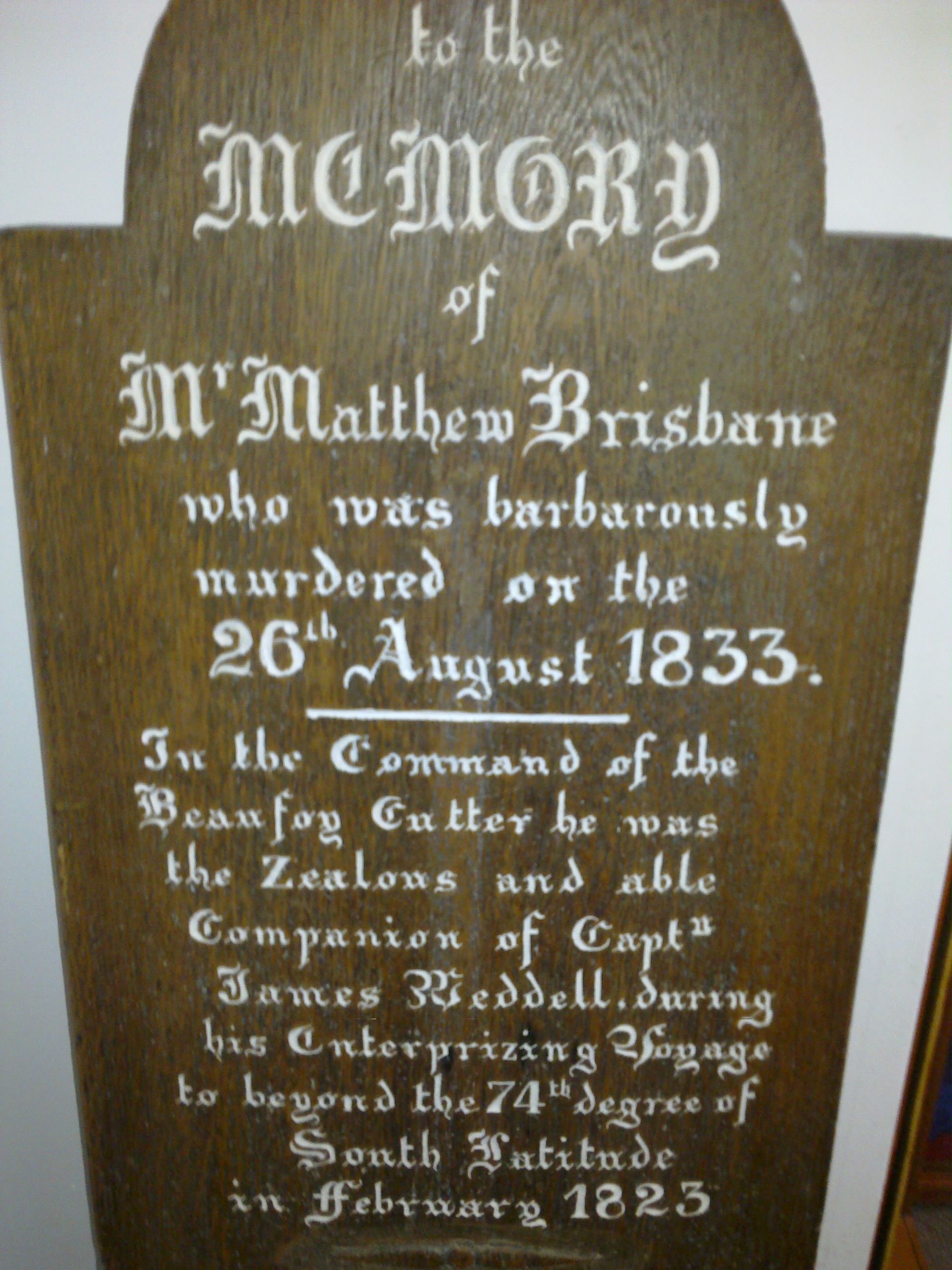
http://upload.wikimedia.org/wikipedia/en/6/6c/Original_Grave_Marker_Matthew_Brisbane_-_Top_Detail.jpgThe Beagle’s Captain Fitzroy returned to the island and was disgusted to find Brisbane in a shallow grave, his feet protruding from the ground.  He wrote: “This was the fate of an honest, industrious, and most faithful man: of a man who feared no danger, and despised hardships. He was murdered by villains, because he defended the property of his friend; he was mangled by them to satisfy their hellish spite; dragged by a lasso, at a horse's heels, away from the houses, and left to be eaten by dogs.” 

In 1842, Brisbane’s remains were moved to a nearby graveyard on East Falkland and a marker erected by the noted Scottish explorer James Clark Ross (1800-62).

Brisbane’s name is commemorated in Brisbane Road in Stanley (Falkland Islands), Cape Brisbane on Henderson Island (Tierra del Fuego) and Brisbane Heights on Coronation Island (South Orkney Islands). 

Bruce Gittings’ interest in the subject stems from his work on the Gazetteer for Scotland, an authoritative web site which attempts to catalogue the bens and glens of Scotland, together with the people who inhabited them.  This work has been ongoing since 1995 and now represents a massive body of information.


The Royal Scottish Geographical Society celebrates exploration through its collections and education work, and the Society’s  visitor centre in The Fair Maid’s House, Perth.

www.rsgs.org

Monday, 4 February 2013

Romania: Learning to Love Europe's Wild Child. Tessa Dunlop.


Tessa Dunlop, a broadcaster, writer and historian with a special interest in Romanian culture and history, will speak on her 20 year odyssey through modern day Romania in talks in Kirkcaldy, Edinburgh and Glasgow on 18th and 20th of February.

Tessa Dunlop has close ties to Romania. She first went to Romania aged eighteen shortly after the Revolution. Tessa is the author of the book To Romania With Love, the story of how one young Romanian boy and his country changed her life forever.  She is fascinated by the country’s history, including the story of Princess Marie, granddaughter of Queen Victoria who became the ‘Soldier Queen’ of Romania. Romania is a beautiful country riddled with corruption. 

Tessa Dunlop.
Tessa Dunlop is a writer, broadcaster and historian with a passion for Romania.

These talks are part of the Royal Scottish Geographical Society’s Inspiring People talks programme.
Tessa is a television presenter, radio broadcaster and historian. She is currently a presenter and historian on BBC Two’s Coast. She has presented history programmes on BBC1 London, BBC2, Discovery Europe, Channel 4, UKTV History and the History Channel (USA).


Tessa’s talk ‘Romania: Learning to Love Europe’s Wild Child’ takes place at the following times and venues.

Kirkcaldy: Monday 18th February at 7.30pm. 
School of Midwifery, University of Dundee Fife Campus, 5 Forth Avenue, Kirkcaldy, KY2 5YS. Edinburgh: Wednesday 20th February at 2:15pm.
Appleton Tower, 11 Crichton Street, Edinburgh, EH8 9LE.
Glasgow: Wednesday 20th February at 7:30pm.
Boyd Orr Building, University of Glasgow, University Ave, Glasgow, G2 4JP.

Tickets are £8 for adults, (redeemable if buying membership) and free for students, under 18s and for RSGS members. Tickets are available on the day from the venue. For more information about any talks this season please visit www.rsgs.org/events/