The Royal Scottish Geographical Society is backing a new campaign to promote, extend and maintain the level of Earth science content in Scottish high schools.
Earth Science Education Scotland
Earth Science Education Scotland is a wide group of people who are interested in Earth science in Scotland. Supported by the RSGS, they have come together due to concern at the very low content of Earth science in the Scottish schools’ curriculum.
Earth Science Education Scotland are currently lobbying the Scottish Government, Education Scotland, the Scottish Qualifications Authority (SQA) to ensure that the planned cessation of the Higher geology certificate in 2015 is postponed until a new Earth science Higher is created. A recent survey undertaken by the group has demonstrated the enthusiasm for teaching the subject at higher level in Scottish schools.
Find out more about Earth Science Education Scotland by visiting the campaign website, which explains the background to the campaign.
http://www.earthscienceeducationscotland.com
The Royal Scottish Geographical Society (RSGS) is an educational charity which promotes an understanding of the natural environment and human societies, and their interactions, making the connections between people, places and the planet, and aiming to inspire positive long-term change. Follow this blog to find out the latest news about the Society, keep up with 'Inspiring People' - our talks programme - and find out how you can become involved in our work.
Showing posts with label Scotland Rocks. Show all posts
Thursday, 5 June 2014
Thursday, 19 December 2013
Professor Iain Stewart receives award from American Geophysical Union
The Society's President, Professor Iain Stewart, was awarded with the Athelstan Spilhaus award by the American Geophysical Union.
The Athelstan Spilhaus Award is awarded not more than once annually to an individual AGU member for devoting portions of their career to conveying to the general public the excitement, significance, and beauty of the Earth and space sciences. Outreach activities may be through books, essays, newspaper articles, speeches, films or photographic displays, exhibits, radio or television pieces, interviews, web sites, or other media; the goal being to reach wide audiences and enhance public understanding in settings distinct from formal education. Robert H. Eather was the first recipient of the Spilhaus Award in 2006.
Professor Stewart is well known for the films he has made with the BBC, including Rise of the Continents, How Earth Made Us and Earth: The Power of the Planet. He has been President of the RSGS since February 2012.
AGU formally recognised the 2013 Union Awardees, Medalists, and Prize recipient during their Honors Tribute, held at the Fall Meeting in San Francisco, California on 11th December.
Established in 2003, the Spilhaus Award is named in honor of geophysicist and meteorologist Athelstan F. Spilhaus Sr. who enthusiastically made innovative contributions to science, education, and public service. He was a scientist, inventor, innovator, cartoonist, and leader in the geosciences community. His outreach to the general public included an informative science center at the 1961 Seattle World's Fari and "Our New Age," and a long-running science cartoon in some 100 Sunday newspapers throughout the US.
The Athelstan Spilhaus Award is awarded not more than once annually to an individual AGU member for devoting portions of their career to conveying to the general public the excitement, significance, and beauty of the Earth and space sciences. Outreach activities may be through books, essays, newspaper articles, speeches, films or photographic displays, exhibits, radio or television pieces, interviews, web sites, or other media; the goal being to reach wide audiences and enhance public understanding in settings distinct from formal education. Robert H. Eather was the first recipient of the Spilhaus Award in 2006.
![]() |
| Iain Stewart is Professor of Geoscience Communications at Plymouth University. Image (c) Plymouth University. |
AGU formally recognised the 2013 Union Awardees, Medalists, and Prize recipient during their Honors Tribute, held at the Fall Meeting in San Francisco, California on 11th December.
Established in 2003, the Spilhaus Award is named in honor of geophysicist and meteorologist Athelstan F. Spilhaus Sr. who enthusiastically made innovative contributions to science, education, and public service. He was a scientist, inventor, innovator, cartoonist, and leader in the geosciences community. His outreach to the general public included an informative science center at the 1961 Seattle World's Fari and "Our New Age," and a long-running science cartoon in some 100 Sunday newspapers throughout the US.
Friday, 24 May 2013
MSPs Discuss Future of Geology in Scottish Curriculum at Paliamentary Meeting
![]() |
| Geology outside, and inside, the Scottish Parliament Building. Image © Scottish Parliamentary Corporate Body – 2012. Licensed under the Open Scottish Parliament Licence v1.0. |
We are delighted to report that the issue of retaining geology and earth sciences in the Scottish curriculum was discussed at a parliamentary meeting on Tuesday 21st.
A number of the MSPs who attended a parliamentary lunch and presentation by sixth year pupils from Perth High on the 16th were impressed and added their voices to the call for geology to continue to be well represented in the curriculum.
The decision has been made by the SQA to stop offering Higher geology as an examinable subject. The replacement qualification, environmental science, does not have much earth science content.
Perth High pupils, supported by their teacher Rachel Hay, RSGS Education Officer Dr Joyce Gilbert, Professor Stuart Monro from Our Dynamic Earth, University of St Andrew's Dr Ruth Robinson, and RSGS President Professor Iain Stewart, presented their case for why they feel that geology should continue to feature strongly at senior level.
MSPs Liz Smith, Clare Adamson, Annabelle Ewing and Nanette Milne all referenced the presentation in a discussion about Public Science Engagement Initiatives.
After the page break please find extracts from the full meeting. The full text of the meeting can be found here. (45page pdf, discussion begins p7, geology p12)
Tuesday, 5 March 2013
Scotland Rocks - a Geology Conference for High School Students
The RSGS was behind Scotland Rocks, a conference for Higher Geology students, which took place in Perth on the 3rd and 4th March in Fife and Perth.
Scotland Rocks was a two day conference for what could be the last group of Higher Geology students. The RSGS convened this conference of students, scientists and educationalists in Perth to highlight the threat to geology as an academic discipline.
On Sunday, the students, who represented nearly every student currently studying Geology, were taken on a field trip to St Monans. The goals of the field excursion were to: identify key rocks types around St Monans, interpret depositional environments of sedimentary rocks, make a small geological map and find some geological treasure!
The field trip was led by staff from the University of St Andrews, GeoBus, University of Dundee, British Geological Survey and the Royal Scottish Geographical Society.
On Monday, the students were addressed by the well-known TV presenter and Scottish geologist, Professor Iain Stewart, who is President of the RSGS. They then took part in some fascinating workshops on Volcanoes, Tsunamis, Fossils, Communicating Earth Heritage and Studying Geology at University.
While the conference was organised by RSGS, the original call to action came from Perth High School, where current students are desperate to see that geology continues to be represented in the curriculum.
The RSGS chief executive, Mike Robinson, has called on ministers to ensure that geology had a future in Scottish schools. “We are determined not to see this subject disappear from our schools, or be sliced and diced until there's nothing left,” he said.
“There is a danger that this country, which has led the world in geology and geography, is turning its back on these practical and vital modern sciences through a simple lack of understanding.”
The conference was organised with the help of the Scottish Geodiversity Forum and the University of St Andrews' GeoBus, with workshops and representatives from Geopark Shetland, Perth Museum and Art Gallery, The University of Edinburgh, The University of Dundee and the University of St Andrews.
See the programme for Scotland Rocks here:
http://issuu.com/rsgspubs /docs/scotland_rocks_prog ramme?mode=window
Scotland Rocks was a two day conference for what could be the last group of Higher Geology students. The RSGS convened this conference of students, scientists and educationalists in Perth to highlight the threat to geology as an academic discipline.
On Sunday, the students, who represented nearly every student currently studying Geology, were taken on a field trip to St Monans. The goals of the field excursion were to: identify key rocks types around St Monans, interpret depositional environments of sedimentary rocks, make a small geological map and find some geological treasure!
The field trip was led by staff from the University of St Andrews, GeoBus, University of Dundee, British Geological Survey and the Royal Scottish Geographical Society.
On Monday, the students were addressed by the well-known TV presenter and Scottish geologist, Professor Iain Stewart, who is President of the RSGS. They then took part in some fascinating workshops on Volcanoes, Tsunamis, Fossils, Communicating Earth Heritage and Studying Geology at University.
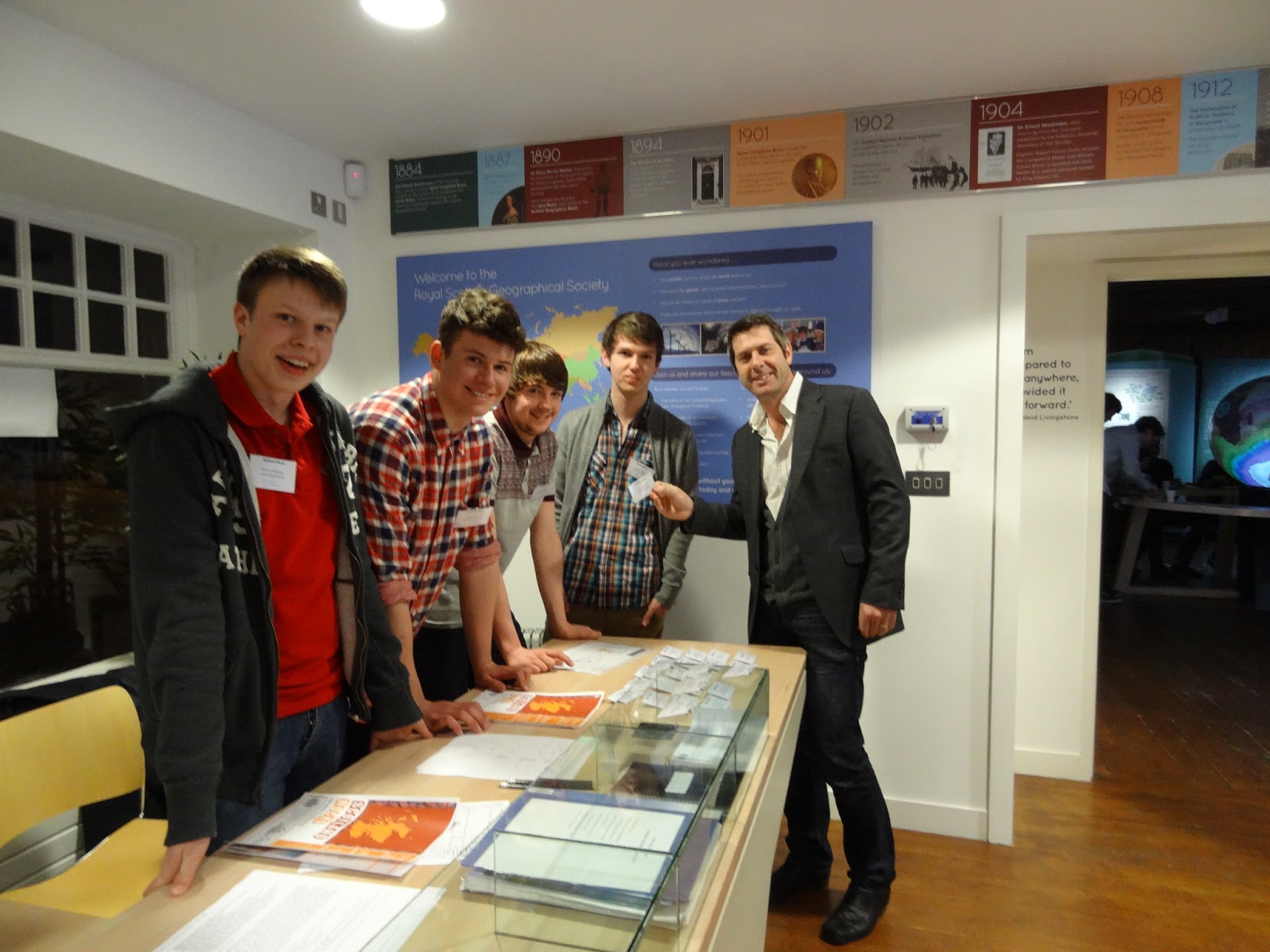
| Professor Iain Stewart with some of the Perth High School Geology students. |
While the conference was organised by RSGS, the original call to action came from Perth High School, where current students are desperate to see that geology continues to be represented in the curriculum.
The RSGS chief executive, Mike Robinson, has called on ministers to ensure that geology had a future in Scottish schools. “We are determined not to see this subject disappear from our schools, or be sliced and diced until there's nothing left,” he said.
“There is a danger that this country, which has led the world in geology and geography, is turning its back on these practical and vital modern sciences through a simple lack of understanding.”
| Students building an indoor geological map at Perth Concert Hall. |
The conference was organised with the help of the Scottish Geodiversity Forum and the University of St Andrews' GeoBus, with workshops and representatives from Geopark Shetland, Perth Museum and Art Gallery, The University of Edinburgh, The University of Dundee and the University of St Andrews.
See the programme for Scotland Rocks here:
http://issuu.com/rsgspubs
Subscribe to:
Posts (Atom)

UniOfPlymouth.jpg)